(3)
Spend more to get free priority shipping
Great. You will get complimentary priority shipping for free.
Previous registration has been removed from the cart as only one animal registration is allowed at a one time.

Spend more to get free priority shipping
Great. You will get complimentary priority shipping for free.
Previous registration has been removed from the cart as only one animal registration is allowed at a one time.
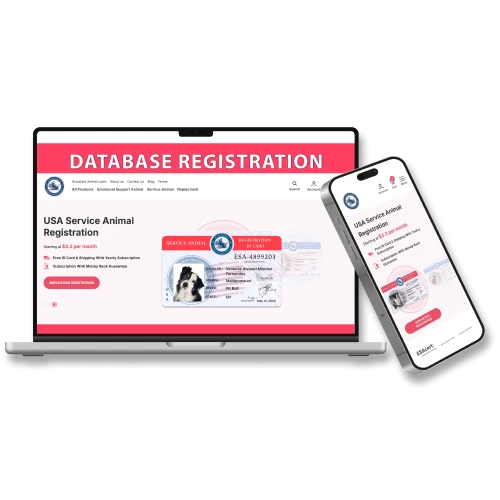
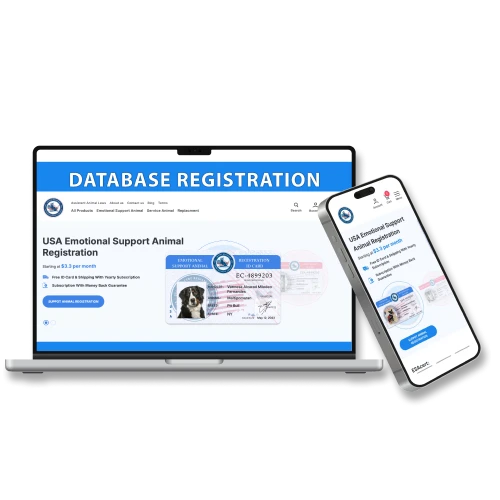
Please note that there is no unified Assistant Animal database registration in the USA.
You cannot verify information from other registrars on the esa-cert.com website

Service dogs can support a wide range of physical, psychiatric, and sensory disabilities when tasks are directly related to the handler’s needs. Eligibility focuses on whether the dog performs trained, disability-mitigating tasks—not on a specific diagnosis list.


Any physical or mental condition can qualify for a service dog if it substantially limits a major life activity, such as walking, seeing, hearing, breathing, concentrating or the work of a major bodily function, and the dog is individually trained to perform tasks that help with that condition. The Americans with Disabilities Act (ADA) uses a functional test instead of a list of diagnoses, so mobility impairments, blindness, deafness, epilepsy, diabetes, PTSD, anxiety disorders, depression, autism, POTS and many other conditions can all qualify.
Two separate things have to be true. The person must have a disability as the ADA defines it, and the dog must be trained to do work or perform tasks directly related to that disability. A diagnosis alone does not make a pet a service dog, and a well-trained dog does not make its owner disabled.
Below you will find the legal definition in plain English, a table that matches common conditions with the tasks dogs are trained for, and a clear answer to who checks whether you qualify.
If you only read one part of this guide, read these points.
Under the ADA, a disability is a physical or mental impairment that substantially limits one or more major life activities, a record of such an impairment, or being regarded as having one. The definition is set out in 42 U.S.C. 12102, which Congress broadened with the ADA Amendments Act of 2008, and the Department of Justice repeats it in its regulations at 28 CFR 35.108 (state and local governments) and 28 CFR 36.105 (businesses open to the public).
The statute spells out what counts as a major life activity, and since 2008 it has also covered the inner workings of the body:
For purposes of paragraph (1), major life activities include, but are not limited to, caring for oneself, performing manual tasks, seeing, hearing, eating, sleeping, walking, standing, lifting, bending, speaking, breathing, learning, reading, concentrating, thinking, communicating, and working.
For purposes of paragraph (1), a major life activity also includes the operation of a major bodily function, including but not limited to, functions of the immune system, normal cell growth, digestive, bowel, bladder, neurological, brain, respiratory, circulatory, endocrine, and reproductive functions.
Source: 42 U.S.C. 12102(2)(A) and (B), U.S. Code text published by the Legal Information Institute at Cornell Law School.
The DOJ regulations add more activities, such as sitting, reaching, writing and interacting with others, and more body systems, including the cardiovascular, hemic, lymphatic and musculoskeletal systems (28 CFR 36.105(c)). Those additions matter for people whose condition is internal and hard to see, like diabetes, epilepsy or a circulatory disorder.
The bar is lower than many people assume. Congress directed that the definition be construed in favor of broad coverage, and the regulations say “substantially limits” is not meant to be a demanding standard. In practice, four rules do most of the work:
One part of the definition does not help with service dogs. Someone who is only “regarded as” having an impairment is not entitled to a reasonable modification of a no-pets policy (42 U.S.C. 12201(h)). A handler needs an actual impairment that substantially limits a major life activity, or a record of one.
The closest thing to a list is a short set of examples in the DOJ regulations, and even that is not a service dog list. According to 28 CFR 36.105(d)(2)(iii), it should be easy to conclude that the following impairments substantially limit at least the activity shown in brackets:
Conditions missing from those examples can still qualify after an individual look at how they affect the person. Generalized anxiety disorder, panic disorder, ADHD, POTS, severe allergies and chronic migraine are common examples. The same regulation names Attention Deficit Hyperactivity Disorder among physical or mental impairments in 28 CFR 36.105(b)(2).
Keep in mind what the examples do and do not prove. A condition on the list shows that you have a disability. It says nothing about whether a dog can be trained to help with it, and that second question is the one that decides whether you have a service dog.
A dog becomes a service dog through training, not through paperwork or its owner’s diagnosis. The DOJ regulations define a service animal this way:
Service animal means any dog that is individually trained to do work or perform tasks for the benefit of an individual with a disability, including a physical, sensory, psychiatric, intellectual, or other mental disability.
Source: 28 CFR 36.104 (the same definition appears in 28 CFR 35.104), Electronic Code of Federal Regulations.
The rest of that definition and the ADA.gov guidance fill in the details:
ADA.gov gives a helpful example for mental health conditions. If a dog has been trained to sense that an anxiety attack is about to happen and take a specific action to help avoid it or lessen its impact, the dog is a service animal. If the dog’s mere presence provides comfort, it is not. That line is the whole difference between psychiatric service dogs and emotional support animals.
Most service dogs work with one of the condition groups in the table below, and each group is matched with examples of trained tasks. The names in the last column are everyday descriptions used by trainers and handlers, not legal categories, and one dog can be trained for tasks from several rows.
| Condition category | Example trained tasks | Type of service dog |
|---|---|---|
| Mobility (spinal cord injury, MS, muscular dystrophy, cerebral palsy, amputation, severe arthritis) | Pull a wheelchair, retrieve dropped items, open doors, provide balance and stability support, brace to help the handler stand | Mobility assistance dog |
| Vision (blindness, low vision) | Guide around obstacles, stop at curbs and steps, find doors, seats and crossings | Guide dog |
| Hearing (deaf, hard of hearing) | Alert to doorbells, alarms, a ringing phone, a crying baby or someone calling the handler’s name, then lead the handler to the sound | Hearing dog |
| Seizure disorders (epilepsy) | Help the handler stay safe during a seizure, get help or activate an alert device, stay with the handler afterward; some dogs are trained to respond at the onset of a seizure | Seizure response dog |
| Diabetes (type 1, type 2) | Alert when blood sugar runs high or low, retrieve a glucose kit or juice, wake the handler or alert another person at night | Diabetic alert dog |
| Psychiatric (PTSD, anxiety and panic disorders, depression, bipolar disorder) | Interrupt a panic attack or dissociation, apply deep pressure on cue, remind the handler to take medication, wake the handler from nightmares, interrupt self-harming behavior | Psychiatric service dog |
| Autism | Interrupt repetitive or self-injurious behavior, provide deep pressure during sensory overload, alert a parent or caregiver, help keep a child from bolting when working with an adult handler | Autism service dog |
| POTS and other invisible conditions (dysautonomia, severe allergies, ADHD, some heart conditions) | Alert to an oncoming fainting episode so the handler can sit or lie down, brace, retrieve medication or water, alert to a specific allergen, interrupt impulsive behavior | Medical alert or medical response dog |
Several of these tasks come straight from the DOJ examples in 28 CFR 36.104: pulling a wheelchair, alerting deaf handlers to sounds, assisting during a seizure, alerting to allergens, retrieving medicine or the phone, balance support, and interrupting impulsive or destructive behaviors for people with psychiatric and neurological disabilities. The others are common training goals. What any single dog can reliably do depends on the dog, the training and the handler, so treat the table as a starting point, not a promise.
These are the best-known service dog roles. A mobility dog might pick up keys the handler cannot reach, pull a door open or steady the handler on stairs. Guide dogs work with people who are blind or have low vision, and hearing dogs work with people who are deaf or hard of hearing. Hearing loss is a sensory disability, and the DOJ definition lists sensory disabilities separately from physical ones.
Both conditions limit major bodily functions (neurological and endocrine), and the DOJ regulations list both among the impairments that should easily be found to be disabilities. ADA.gov describes a dog trained to alert a person with diabetes when blood sugar reaches high or low levels, and a dog trained to detect the onset of a seizure and then help the person remain safe. A dog that simply stays close during a seizure without any trained response is not doing a task.
Psychiatric conditions qualify on the same terms as physical ones when the dog is trained for a specific job. ADA.gov gives the example of a dog trained to lick the hand of a person with PTSD to alert them to an oncoming panic attack, and a dog trained to remind a person with depression to take medication. Veterans often ask about this path, and we cover it in detail in our post on PTSD service dogs for veterans.
The DOJ regulations name autism among the conditions that substantially limit brain function. Dogs are commonly trained to interrupt repetitive or self-injurious behavior or to respond to sensory overload. When the handler is a child, a parent or another adult usually controls the dog in public. Read more about how these partnerships work in our guide to the autism service dog.
Invisible conditions qualify as long as they substantially limit a major life activity or bodily function, even if they come and go. A person with POTS may be limited in standing and in circulatory function, which is why some handlers train dogs to alert before a fainting episode or to brace them while they get to the floor safely. See our posts on the POTS service dog and the ADHD service dog for task ideas and training notes.
In everyday life you decide, as the handler, whether you and your dog meet the definitions above; the ADA has no certifying agency, doctor or registry. If a business disputes it, the question goes to the Department of Justice or a court, which applies the same definitions.
Staff at a store, restaurant, hotel or other public place may check only in a limited way. ADA.gov explains:
In situations where it is not obvious that the dog is a service animal, staff may ask only two specific questions: (1) is the dog a service animal required because of a disability? and (2) what work or task has the dog been trained to perform? Staff are not allowed to request any documentation for the dog, require that the dog demonstrate its task, or inquire about the nature of the person’s disability.
Source: U.S. Department of Justice, Frequently Asked Questions about Service Animals and the ADA, question 7, ADA.gov.
When it is obvious that the dog is working, for example guiding a person who is blind or pulling a wheelchair, staff generally should not ask even those two questions (28 CFR 36.302(c)(6)). Businesses also may not charge a surcharge or pet fee for a service dog, though a handler can be charged for damage the dog causes if other customers are charged for damage too (28 CFR 36.302(c)(8)). Our guide to service dog requirements under the ADA covers access rules in more depth.
A letter from a health care provider is useful in some settings and irrelevant in others:
If you fly, ESAcert’s service dog DOT form kit helps you prepare the paperwork in advance. Always confirm the current process on your airline’s own service animal page before your trip.
If your animal helps simply by being with you, it is an emotional support animal, not a service dog, and it has no ADA public access rights. ADA.gov notes that some state or local governments have laws allowing emotional support animals into public places, so local rules are worth checking.
The difference shows up in three places: what the animal does (trained tasks versus comfort), where it can go (most public places versus mainly housing), and which law protects it. Our side-by-side comparison of a service dog versus an emotional support animal and a therapy dog lays out each role, including the housing rules that apply to each.
You can use a service dog in public without registering or certifying it, and a business cannot make a certificate, ID card or vest a condition of entry (ADA.gov FAQ, question 17). ADA.gov also explains that certificates and registration documents sold online do not create rights under the ADA. Your dog still has to follow the same local licensing and vaccination rules as every other dog.
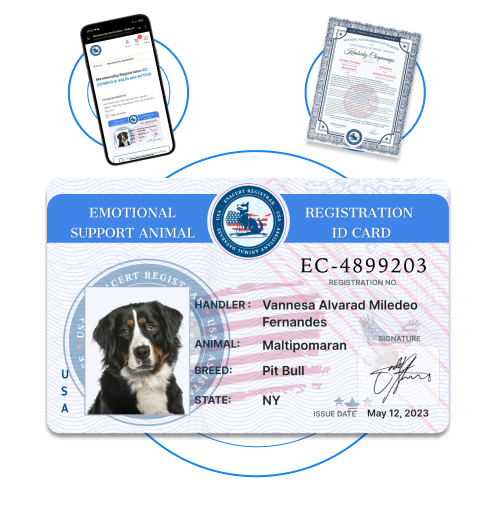
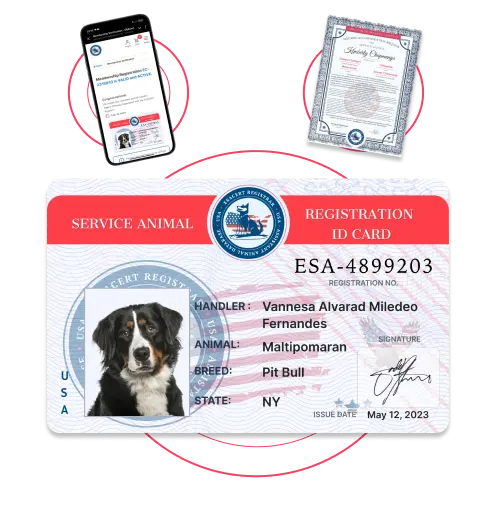
Many handlers choose to carry something anyway. A vest or ID card can signal that the dog is working and cut down on questions at the door, especially with an invisible disability. ESAcert’s service animal registration gives you an ID card and certificate for that purpose. It is a voluntary convenience: it does not prove your disability, and no one is required to accept it as proof.
Start with the two questions the law actually asks. First, does your condition substantially limit a major life activity or bodily function? Second, can a dog be trained to perform a specific task that helps with it?
Any physical or mental impairment that substantially limits a major life activity or major bodily function can qualify. That includes mobility, vision and hearing impairments, epilepsy, diabetes, PTSD, depression, anxiety disorders, autism and invisible conditions like POTS. The dog must also be trained to perform tasks related to the disability.
Yes, if the condition substantially limits a major life activity such as thinking, concentrating, sleeping or interacting with others, and the dog is trained for a specific task. Examples include interrupting a panic attack or reminding you to take medication. A dog that only provides comfort is an emotional support animal, not a service dog.
Not for public access under the ADA. Businesses cannot ask for documentation or about your diagnosis. A letter from your provider can help with a housing accommodation request, while airlines use the DOT Service Animal Air Transportation Form instead of a medical letter.
No federal test or certification exists for ADA service dogs. The dog must be individually trained, under control and housebroken, and you may train it yourself. ID cards and registrations are optional tools that some handlers carry for convenience; they do not create legal rights.
No. Staff may ask only whether the dog is a service animal required because of a disability and what work or task it has been trained to perform. They cannot ask about your condition, request documents or ask the dog to demonstrate a task.
Yes. The ADA definition covers people of any age with a disability. When the handler is a child, for example with autism, a parent or another adult often controls the dog in public, and the dog must still be trained for tasks related to the child’s disability.

A psychiatric service dog (PSD) is a dog individually trained to perform ...
A psychiatric service dog (PSD) is a dog individually trained to perform specific tasks for a person with a mental health disability such as PTSD, panic disorder, major depression or bipolar disorder. Because it is task-trained, a PSD is a service animal under the Americans with Disabilities Act (ADA) and can go with its handler into stores, ...

Delta accepts fully trained service dogs in the cabin at no charge, while ...
Delta accepts fully trained service dogs in the cabin at no charge, while emotional support animals travel only under Delta's pet rules. To fly with a service dog, you complete the U.S. DOT Service Animal Air Transportation Form and send it to Delta with a service request, ideally at least 48 hours before departure.
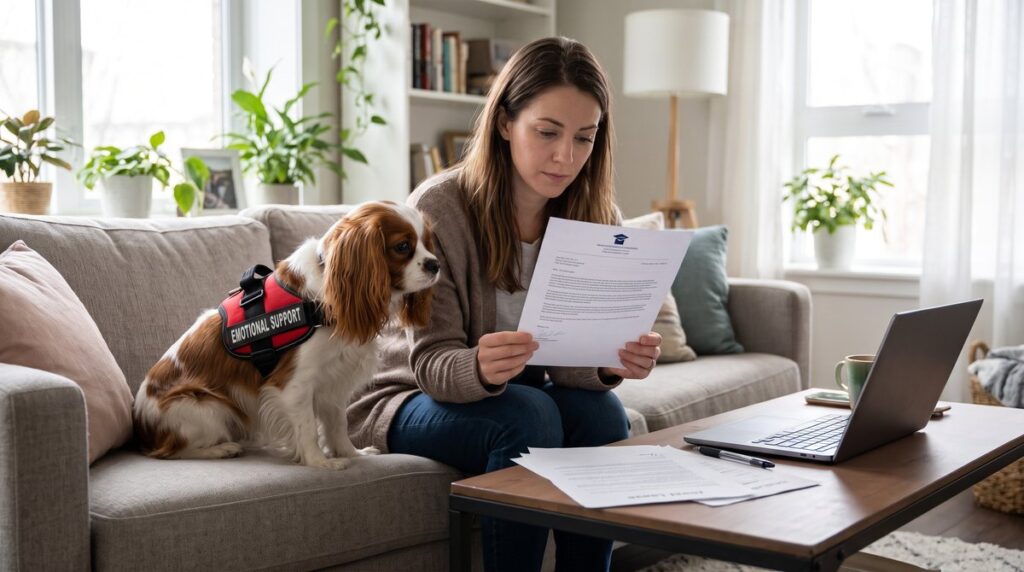
A valid emotional support animal letter is a short document from a licensed ...
A valid emotional support animal letter is a short document from a licensed health care professional who has evaluated you and believes you have a disability-related need for an emotional support animal. A strong letter is personal to you, written on the provider's letterhead, shows how to verify the license, and connects the animal to how your ...
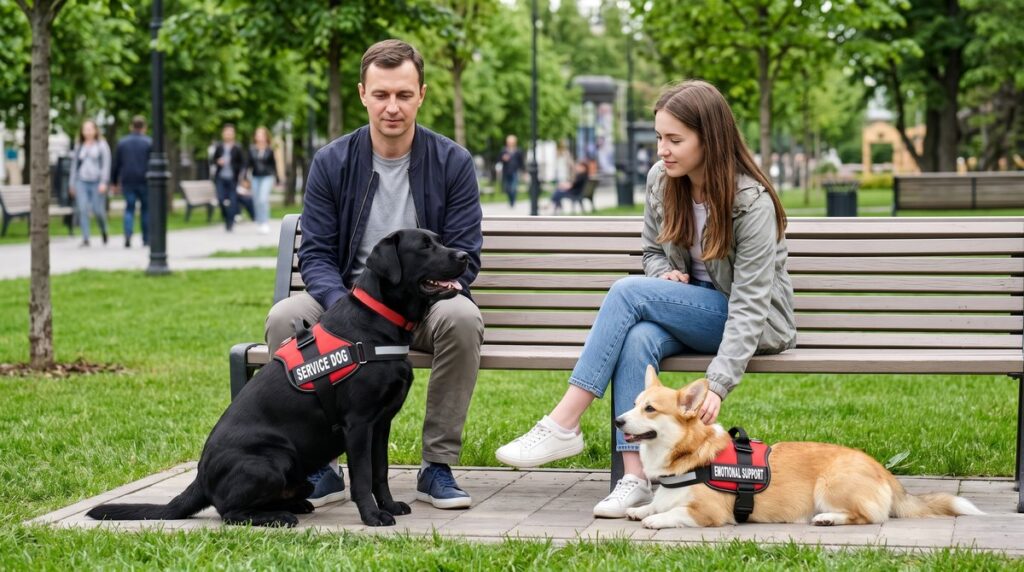
A service dog is individually trained to perform specific tasks for a ...
A service dog is individually trained to perform specific tasks for a person with a disability and can go with its handler into most places open to the public. An emotional support animal (ESA) helps through its presence, is not task-trained, and has no ADA right to enter stores, restaurants, or hotels. A therapy dog visits hospitals, schools, and ...

Yes — the animal itself is still protected. What changed on 22 May 2026 is ...
Yes — the animal itself is still protected. What changed on 22 May 2026 is federal enforcement of pet-fee waivers, and the answer now depends on your state. Updated with the California Civil Rights Department alert of 20 July 2026.

Most people don't realize that California's "no pets" policies cannot be ...
Most people don't realize that California's "no pets" policies cannot be used to deny an emotional support animal. Emotional Support Animal Laws in California give you real, enforceable rights. If your landlord is refusing your ESA based on a no-pet clause, they may be violating both federal and state law. This guide breaks down what those ...

Yes, Virginia protects emotional support animals in housing. The Virginia ...
Yes, Virginia protects emotional support animals in housing. The Virginia Fair Housing Law defines an "assistance animal" to include an animal that provides emotional support for a person's disability (Va. Code § 36-96.1:1), and a separate section, § 36-96.3:1, sets out how a landlord may verify the request and what the tenant pays. Renting with ...

An emotional support animal in Georgia is protected mainly at home: the ...
An emotional support animal in Georgia is protected mainly at home: the federal Fair Housing Act and the Georgia Fair Housing Law (O.C.G.A. § 8-3-200 and following) let you ask a landlord to set aside a no-pets rule as a reasonable accommodation. Outside housing, an ESA has no public access rights, and since July 1, 2026 Georgia law spells that ...
Price:
Your current registration:
After change, your registration will be:
Your current registration:
will be replaced with:
You have entered the maximum number of characters
You have entered the maximum number of characters
You have entered the maximum number of characters
You have entered the maximum number of characters
You have entered the maximum number of characters
EC-0000001
Nov 17, 2026
-
-
-
-
-
-
You have entered the maximum number of characters
You have entered the maximum number of characters
You have entered the maximum number of characters
You have entered the maximum number of characters
You have entered the maximum number of characters
You have entered the maximum number of characters
You have entered the maximum number of characters
Enter at least 3 characters to search. You have entered: