(3)
Spend more to get free priority shipping
Great. You will get complimentary priority shipping for free.
Previous registration has been removed from the cart as only one animal registration is allowed at a one time.

Spend more to get free priority shipping
Great. You will get complimentary priority shipping for free.
Previous registration has been removed from the cart as only one animal registration is allowed at a one time.
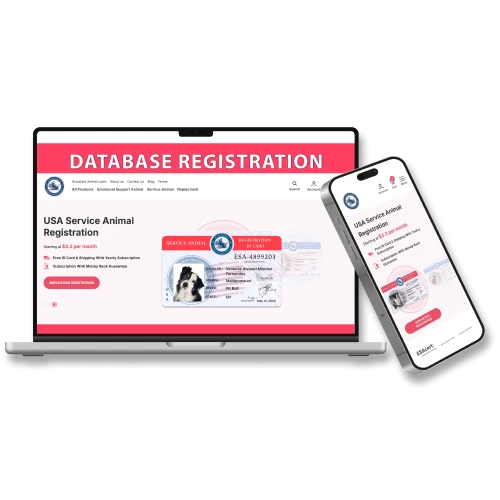
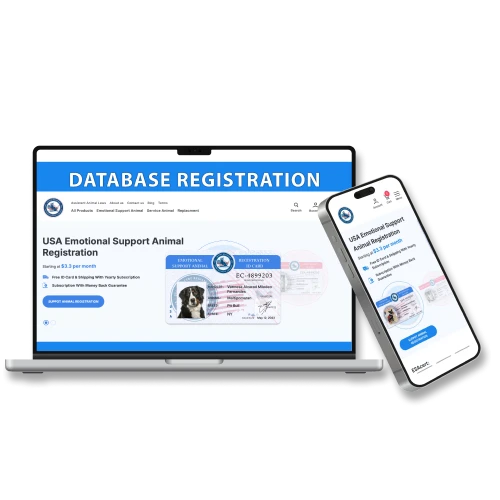
Please note that there is no unified Assistant Animal database registration in the USA.
You cannot verify information from other registrars on the esa-cert.com website

Refusing a legitimate service dog can lead to fines, civil penalties, and discrimination claims under ADA rules. Clear policies, staff training, and proper communication help businesses avoid legal issues and support accessible service.


The penalty for refusing a service dog depends on who brings the case and where the refusal happened. Under the federal Americans with Disabilities Act (ADA), a handler who sues a business can win a court order and attorney’s fees, while the U.S. Department of Justice can ask a court for a civil penalty of up to $118,225 for a first violation. State laws often add more: California sets minimum damages of $4,000 per offense, and Florida, Texas and Michigan treat an unlawful refusal as a misdemeanor.
Below you will find the current federal figures and the year they apply to, a state comparison table with statute sections, and a step-by-step plan for what to do if you are turned away. Housing and airline refusals follow different laws, so they get their own section, along with the penalties some states impose on people who pass off a pet as a service dog.
A business that turns away a trained service dog without a lawful reason violates Title III of the ADA, but the consequences depend on who enforces the law. A private lawsuit usually ends with an order to change the policy and a fee award, while a Justice Department case can add civil penalties and damages for the people affected.
Under 28 CFR 36.501, a person who faces disability discrimination may file a civil action for preventive relief, such as a temporary or permanent injunction or a restraining order. The rule does not give the individual a right to money damages under federal law. It does shift legal costs: under 28 CFR 36.505, the court may award the winning side a reasonable attorney’s fee, litigation expenses and costs.
In plain terms, a federal ADA claim on its own tends to produce a changed policy, staff training and a bill for the handler’s legal fees. Money damages for the handler usually come from state law, which is why the state table below matters so much.
The Department of Justice can also take a business to court. In those cases, 28 CFR 36.504 lets the court order policy changes, award monetary damages to the people harmed when the Attorney General asks for them, and assess a civil penalty to vindicate the public interest. Punitive damages are excluded, and several discriminatory acts found in a single lawsuit count as one violation.
The penalty caps are adjusted for inflation in 28 CFR 85.5. The figures you often see online, $75,000 and $150,000, are the base amounts written into the ADA regulation. They are no longer the current caps.
| ADA Title III violation | Base amount in 28 CFR 36.504 | Current maximum (penalties assessed after July 3, 2025) |
|---|---|---|
| First violation | $75,000 | $118,225 |
| Subsequent violation | $150,000 | $236,451 |
In a Federal Register notice of July 15, 2026, the Justice Department said there would be no cost-of-living adjustment for 2026, so the 2025 levels stay in place for penalties assessed in 2026. These are maximums: a court decides the actual amount, and the DOJ does not take every complaint to court.
Most refusals start with a question staff are not allowed to ask. According to ADA.gov, when it is not obvious what a dog does, staff may ask only two things: whether the dog is a service animal required because of a disability, and what work or task it has been trained to perform. They cannot ask about the disability, demand medical papers, an ID card or training records, or ask the dog to demonstrate its task.
ADA.gov also says allergies and fear of dogs are not valid reasons to refuse service. Handlers cannot be isolated from other customers or charged fees that others do not pay, and a pet deposit or pet fee must be waived for a service animal. The only grounds for removal are narrow ones:
A person with a disability cannot be asked to remove his service animal from the premises unless: (1) the dog is out of control and the handler does not take effective action to control it or (2) the dog is not housebroken. When there is a legitimate reason to ask that a service animal be removed, staff must offer the person with the disability the opportunity to obtain goods or services without the animal’s presence.
Source: ADA Requirements: Service Animals, U.S. Department of Justice, ADA.gov.
State laws sit on top of the ADA and are where most money damages and criminal penalties come from. The table covers six states whose current statute text we checked on the official legislature sites in November 2026.
| State | Penalty for refusing a service dog | Statute | Penalty for misrepresenting a pet as a service dog | Statute |
|---|---|---|---|---|
| California | Civil: actual damages up to three times, but at least $4,000 per offense (Unruh Act) or at least $1,000 per offense (Disabled Persons Act), plus attorney’s fees; not both for the same act. Criminal: misdemeanor, fine up to $2,500. | Civ. Code 52(a), 54.3; Penal Code 365.5(c) | Misdemeanor: up to 6 months in county jail, a fine up to $1,000, or both | Penal Code 365.7 |
| New York | Classed as a violation; two or more refusals within two years: $1,000 fine | Civil Rights Law 47, 47-c | Not listed in these sections | – |
| Texas | Misdemeanor: fine up to $300 plus 30 hours of community service; in a civil suit, damages of at least $300 are presumed | Human Resources Code 121.003, 121.004 | Misdemeanor: fine up to $1,000 plus 30 hours of community service | Human Resources Code 121.006(a) |
| Florida | Second-degree misdemeanor: up to 60 days in jail or a fine up to $500, plus 30 hours of community service | Fla. Stat. 413.08(4), 775.082, 775.083 | Second-degree misdemeanor plus 30 hours of community service | Fla. Stat. 413.08(9) |
| Michigan | Misdemeanor for a public accommodation that violates the service animal rules | MCL 750.502c(13) | Misdemeanor: up to 90 days in jail, a fine up to $500, up to 30 days of community service, or a combination | MCL 752.62, 752.63 |
| Washington | Unfair practice under the state anti-discrimination law (civil, not criminal) | RCW 49.60.215 | Civil infraction | RCW 49.60.214 |
Laws change, and many other states have their own service animal statutes. Before you rely on a number, open your state’s code on the legislature’s website or ask your state civil rights agency.
California has the strongest money remedies in the table, and most of them come from civil rights law rather than criminal fines. Civil Code 51(f) says any violation of the federal ADA also counts as a violation of the Unruh Civil Rights Act, and Civil Code 52(a) sets damages for each offense at no less than $4,000, plus attorney’s fees.
The Disabled Persons Act adds a second route. Civil Code 54.3 makes a business liable for at least $1,000 per offense when it denies or interferes with access, and it defines interference to include preventing a service dog from doing its job. You cannot collect under both 52 and 54.3 for the same act. The same section lets you file a verified complaint with the California Civil Rights Department.
The older post on this page called the $4,000 a fine. It is not paid to the state: it is a minimum amount of damages a court can award to the person who was refused, usually after a lawsuit. The criminal side is separate:
(c) Any person, firm, association, or corporation, or the agent of any person, firm, association, or corporation, who prevents a disabled person from exercising, or interferes with a disabled person in the exercise of, the rights specified in this section is guilty of a misdemeanor, punishable by a fine not exceeding two thousand five hundred dollars ($2,500).
Source: California Penal Code section 365.5, California Legislative Information.
If you are turned away, stay calm, write down everything while it is fresh, and then file a complaint with the Justice Department and your state civil rights agency. For money damages under state law, talk to a disability rights lawyer.
After you file with the DOJ, ADA.gov says the department may refer your complaint to its ADA Mediation Program or to another federal agency, contact you for more details, or investigate, which can lead to a settlement or a lawsuit. It also says it cannot investigate every complaint, and that its review can take up to three months. If you have not heard back by then, call the ADA Information Line at 800-514-0301 (voice) or 1-833-610-1264 (TTY), Monday through Friday.
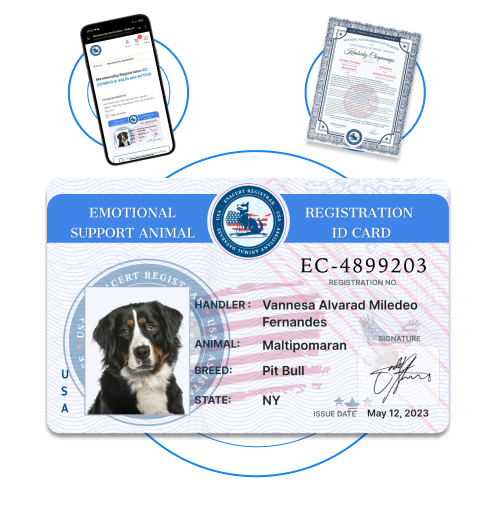
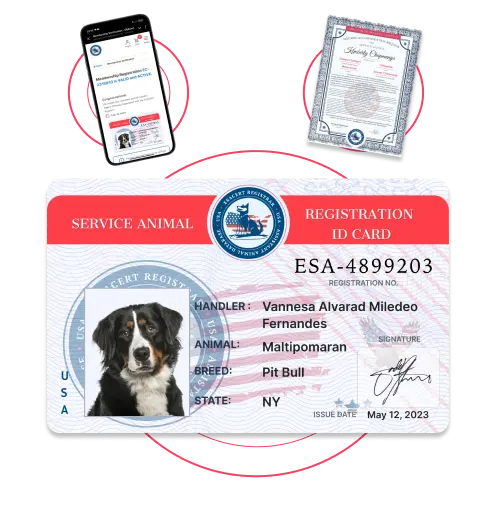
The ADA does not require any certificate, registration or ID card, and ADA.gov states that online certification and registration documents do not convey rights under the ADA and are not proof that a dog is a service animal. Some handlers still carry a card that lists the dog’s trained task, because it answers the two allowed questions quickly and can end an awkward exchange before it turns into a refusal. If that sounds useful, a service animal ID card is a convenience you can show, not a legal pass. For a closer look at what these products can and cannot do, see whether service dog registration is legit.
Refusals at home, on a plane or at work are handled by different laws and different agencies. ADA.gov sends housing complaints to HUD, air travel complaints to the Department of Transportation and employment complaints to the EEOC.
Landlords and housing providers must make reasonable accommodations for people with disabilities under the federal Fair Housing Act (42 U.S.C. 3604(f)(3)(B) and 24 CFR 100.204). An aggrieved person may file a complaint with HUD no later than one year after the discriminatory practice, or file a lawsuit within two years, and in a lawsuit the court may award actual and punitive damages (42 U.S.C. 3610 and 3613).
HUD’s enforcement picture changed in 2025 and 2026: it withdrew its earlier assistance animal guidance, and a May 22, 2026 memo says HUD will pursue charges only for animals trained to provide disability-related assistance. A trained service dog falls inside that line, and private lawsuits and state laws are still available. Our post on HUD’s 2026 housing rule changes walks through what that means for tenants.
Airlines are covered by the Air Carrier Access Act and the DOT rule in 14 CFR Part 382, not by ADA Title III. If an airline refuses your service dog, ask for the Complaints Resolution Official: under 14 CFR 382.151, U.S. airlines must make one available at every airport they serve, in person or by phone. A written complaint sent to the airline within 45 days of the incident must get a written answer within 30 days that admits or denies a violation (14 CFR 382.155).
You can also file a complaint with the Department of Transportation. Under 14 CFR 382.159, file within six months of the incident to make sure DOT investigates. Airlines may require the DOT Service Animal Air Transportation Form, and a DOT form kit can help you have it ready before you fly. Our guide on how to fly with a service animal legally covers the rest of the process.
If an employer refuses to let you bring a service dog to work, that is an employment question under ADA Title I. ADA.gov directs these cases to the Equal Employment Opportunity Commission, which explains how to file a charge of discrimination.
Not every refusal breaks the law. A business may remove a dog that is out of control or not housebroken, and it does not have to admit emotional support animals or pets as service animals.
ADA.gov explains that animals that provide comfort just by being with a person are not trained for a specific task, so they do not qualify as service animals under the ADA, though some state or local laws allow emotional support animals in public places. The ADA also requires a dog to be trained before it goes into public places as a service animal, while some state laws cover dogs still in training. If you are unsure which category your dog falls into, our comparison of service dogs, emotional support animals and therapy dogs sorts it out, and our guide to service dog requirements under the ADA covers the training standard.
Several states punish the other side of the problem, too. Passing off a pet as a service dog is a misdemeanor in California (Penal Code 365.7), Florida (413.08(9)), Texas (Human Resources Code 121.006) and Michigan (MCL 752.62 and 752.63), and a civil infraction in Washington (RCW 49.60.214). Florida and Texas add 30 hours of community service.
The simplest way to avoid a service dog penalty is to train staff on the two allowed questions and the two removal grounds. The rules are short, and a front-desk employee who knows them can head off a complaint in a minute.
For handlers, the practical next step is simple: save this page, keep notes on any refusal, and file the DOJ complaint the same week while the details are fresh.
Under federal law, a business can be ordered to change its policy and pay the handler’s attorney’s fees, and in DOJ lawsuits it can face civil penalties of up to $118,225 for a first violation and $236,451 for a later one. State law adds more: California allows at least $4,000 in damages per offense, and Florida, Texas and Michigan make refusal a misdemeanor.
Not under the federal ADA alone. A private ADA Title III lawsuit gives injunctive relief and attorney’s fees, not damages. Money damages usually come from state law, such as California’s Unruh Civil Rights Act or Disabled Persons Act, or from a DOJ case where the Attorney General asks for damages for the people harmed.
File online through the DOJ Civil Rights Division’s report form at civilrights.justice.gov, or mail the ADA Complaint Form or a letter to the Civil Rights Division at 950 Pennsylvania Avenue, NW, Washington, DC 20530. Airline refusals go to the Department of Transportation, housing refusals to HUD and workplace refusals to the EEOC.
No. Staff may ask only whether the dog is required because of a disability and what task it is trained to perform. Registration and ID cards are voluntary: some handlers find a card handy for answering those questions, but it gives no extra legal rights.
In stores, restaurants and hotels, generally no, because emotional support animals are not service animals under the ADA, although some state or local laws allow them in public places. Housing is different: the Fair Housing Act still requires reasonable accommodations, and state laws may give more protection.
It depends on the state. In California it is a misdemeanor punishable by up to six months in jail and a fine of up to $1,000, in Texas a fine of up to $1,000 plus 30 hours of community service, and in Washington a civil infraction.

A psychiatric service dog (PSD) is a dog individually trained to perform ...
A psychiatric service dog (PSD) is a dog individually trained to perform specific tasks for a person with a mental health disability such as PTSD, panic disorder, major depression or bipolar disorder. Because it is task-trained, a PSD is a service animal under the Americans with Disabilities Act (ADA) and can go with its handler into stores, ...

Delta accepts fully trained service dogs in the cabin at no charge, while ...
Delta accepts fully trained service dogs in the cabin at no charge, while emotional support animals travel only under Delta's pet rules. To fly with a service dog, you complete the U.S. DOT Service Animal Air Transportation Form and send it to Delta with a service request, ideally at least 48 hours before departure.
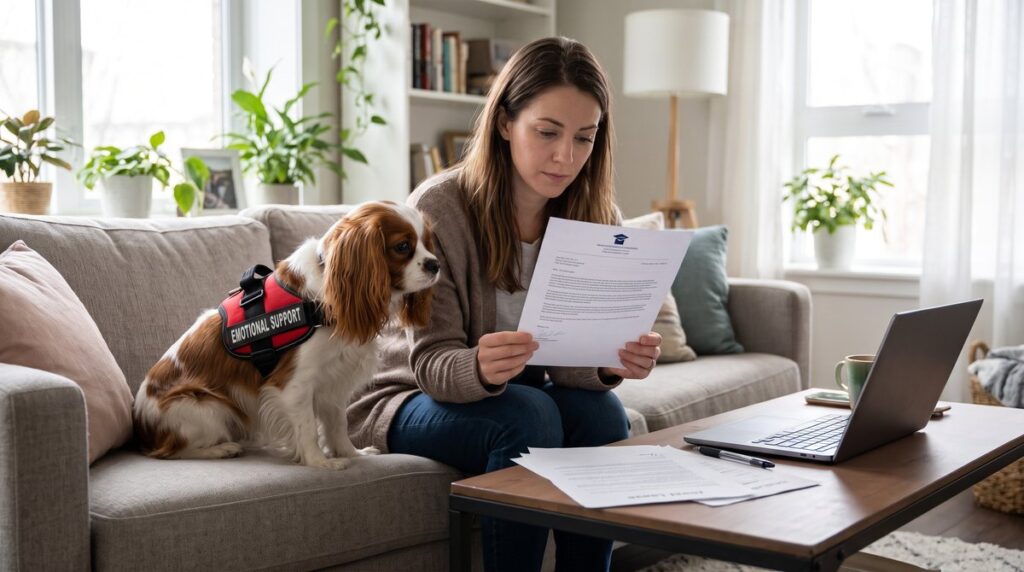
A valid emotional support animal letter is a short document from a licensed ...
A valid emotional support animal letter is a short document from a licensed health care professional who has evaluated you and believes you have a disability-related need for an emotional support animal. A strong letter is personal to you, written on the provider's letterhead, shows how to verify the license, and connects the animal to how your ...
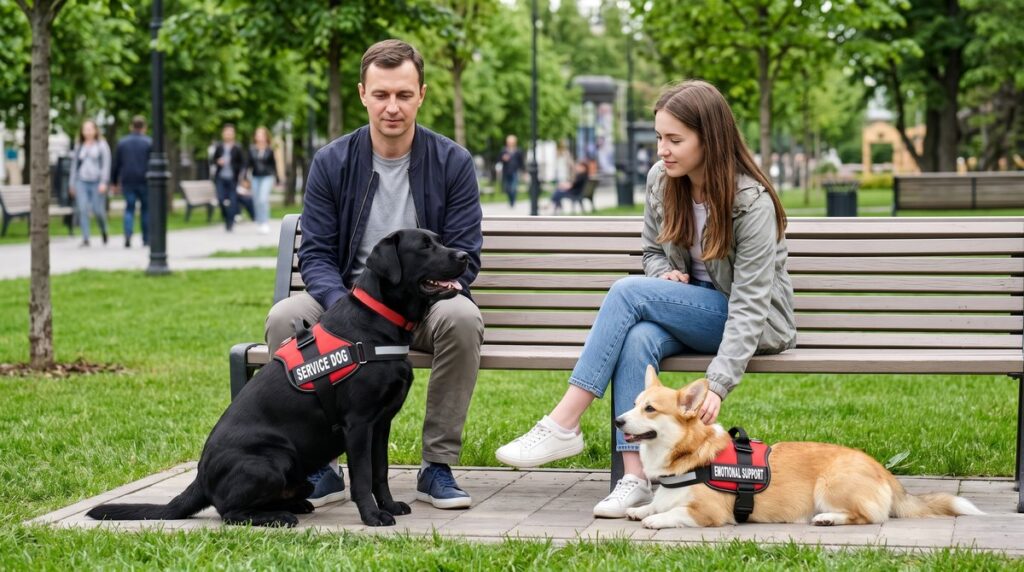
A service dog is individually trained to perform specific tasks for a ...
A service dog is individually trained to perform specific tasks for a person with a disability and can go with its handler into most places open to the public. An emotional support animal (ESA) helps through its presence, is not task-trained, and has no ADA right to enter stores, restaurants, or hotels. A therapy dog visits hospitals, schools, and ...

Yes — the animal itself is still protected. What changed on 22 May 2026 is ...
Yes — the animal itself is still protected. What changed on 22 May 2026 is federal enforcement of pet-fee waivers, and the answer now depends on your state. Updated with the California Civil Rights Department alert of 20 July 2026.

Most people don't realize that California's "no pets" policies cannot be ...
Most people don't realize that California's "no pets" policies cannot be used to deny an emotional support animal. Emotional Support Animal Laws in California give you real, enforceable rights. If your landlord is refusing your ESA based on a no-pet clause, they may be violating both federal and state law. This guide breaks down what those ...

Yes, Virginia protects emotional support animals in housing. The Virginia ...
Yes, Virginia protects emotional support animals in housing. The Virginia Fair Housing Law defines an "assistance animal" to include an animal that provides emotional support for a person's disability (Va. Code § 36-96.1:1), and a separate section, § 36-96.3:1, sets out how a landlord may verify the request and what the tenant pays. Renting with ...

An emotional support animal in Georgia is protected mainly at home: the ...
An emotional support animal in Georgia is protected mainly at home: the federal Fair Housing Act and the Georgia Fair Housing Law (O.C.G.A. § 8-3-200 and following) let you ask a landlord to set aside a no-pets rule as a reasonable accommodation. Outside housing, an ESA has no public access rights, and since July 1, 2026 Georgia law spells that ...
Price:
Your current registration:
After change, your registration will be:
Your current registration:
will be replaced with:
You have entered the maximum number of characters
You have entered the maximum number of characters
You have entered the maximum number of characters
You have entered the maximum number of characters
You have entered the maximum number of characters
EC-0000001
Nov 17, 2026
-
-
-
-
-
-
You have entered the maximum number of characters
You have entered the maximum number of characters
You have entered the maximum number of characters
You have entered the maximum number of characters
You have entered the maximum number of characters
You have entered the maximum number of characters
You have entered the maximum number of characters
Enter at least 3 characters to search. You have entered: