(3)
Spend more to get free priority shipping
Great. You will get complimentary priority shipping for free.
Previous registration has been removed from the cart as only one animal registration is allowed at a one time.

Spend more to get free priority shipping
Great. You will get complimentary priority shipping for free.
Previous registration has been removed from the cart as only one animal registration is allowed at a one time.
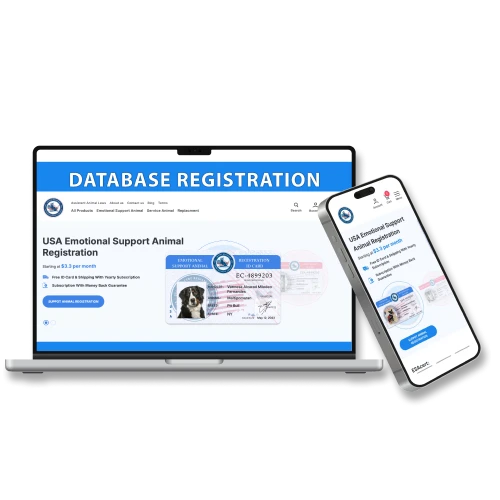
Please note that there is no unified Assistant Animal database registration in the USA.
You cannot verify information from other registrars on the esa-cert.com website

A service dog is individually trained to perform specific tasks for a person with a disability and can go with its handler into most places open to the public. An emotional support animal (ESA) helps through its presence, is not task-trained, and has no ADA right to enter stores, restaurants, or hotels. A therapy dog visits hospitals, schools, and ...

A service dog is individually trained to perform specific tasks for a person with a disability and can go with its handler into most places open to the public. An emotional support animal (ESA) helps through its presence, is not task-trained, and has no ADA right to enter stores, restaurants, or hotels. A therapy dog visits hospitals, schools, and care homes with its handler to comfort other people and has no special legal access at all.
The categories look alike from the outside, but the rules attached to each one differ in ways that matter at an apartment office, a store entrance, or an airport gate. Psychiatric service dogs cause the most confusion: they may look like ESAs, yet they are full service animals because they perform trained tasks tied to a psychiatric disability.
Match the category to the help you actually need:
Service dog (including psychiatric service dog): for a person with a disability who benefits from trained tasks such as seizure response, medication reminders, or balance support.
Emotional support animal: for a person whose licensed mental health or medical professional recommends an animal’s companionship as part of treatment, mainly at home.
Therapy dog: for owners of calm, well-socialized dogs who want to volunteer in hospitals, nursing homes, or schools.
Under the Americans with Disabilities Act (ADA), a service animal is a dog individually trained to do work or perform tasks for a person with a disability, whether physical, sensory, psychiatric, intellectual, or another mental disability (28 CFR 35.104 and 36.104). Miniature horses are handled by a separate, narrower provision of the regulations. To see which conditions can qualify, read ESAcert’s guide to what disabilities qualify for a service dog.
The task has to be a trained action connected to the disability. ADA.gov gives examples such as guiding people who are blind, alerting people who are deaf, pulling a wheelchair, protecting a person during a seizure, reminding a person with mental illness to take medication, and calming a person with PTSD during an anxiety attack. Comfort by itself does not count:
“Dogs whose sole function is to provide comfort or emotional support do not qualify as service animals under the ADA.”
The dividing line is a trained response versus general comfort. The ADA.gov FAQ explains that a dog trained to sense an oncoming anxiety attack and take a specific action to help avoid it or lessen it qualifies as a service animal, while a dog whose mere presence provides comfort does not. Other psychiatric tasks include medication reminders and, for a veteran with PTSD, checking a room and signaling that it is safe to enter.
An emotional support animal is a companion animal that eases symptoms of a mental or emotional condition through its presence. ESAs need no task training, and they are not limited to dogs; cats are common too. What makes an animal an ESA in practice is a recommendation from a licensed mental health or medical professional who has evaluated the person.
ESAs have no public access rights under the ADA, so a store or restaurant can apply its normal pet policy. ADA.gov does note that some state or local governments have laws allowing ESAs in public places, so check local rules. In housing, ESAs are still handled as a reasonable accommodation request, which is covered in detail below.
A therapy dog is a pet that visits hospitals, nursing homes, schools, and similar settings with its handler to comfort many people. Therapy dogs are usually evaluated for temperament and obedience by a therapy animal organization, but they are not trained to perform tasks for one person with a disability.
ADA.gov groups therapy animals with comfort and companion animals: they are not service animals under the ADA. A therapy dog enters a facility by invitation and under that facility’s rules, and in housing and on flights it is treated like any other pet.
|
Category |
Service Dog (incl. Psychiatric) |
Emotional Support Animal |
Therapy Dog |
|---|---|---|---|
|
Primary purpose |
Perform tasks for one handler’s disability |
Provide emotional comfort to one owner |
Comfort groups of people in facilities |
|
Training |
Individually trained for disability-related tasks |
No task training required |
Temperament and obedience screening |
|
Species |
Dogs only (miniature horses under a separate rule) |
Not limited to dogs |
Typically dogs |
|
Main federal law |
ADA (Titles II and III); Fair Housing Act; Air Carrier Access Act |
Fair Housing Act; state laws |
None for access; facility policies |
|
Stores, restaurants, hotels |
Yes, under the ADA |
No ADA right (some state or local laws differ) |
Only by invitation |
|
Housing with “no pets” rules |
Reasonable accommodation under the Fair Housing Act |
Reasonable accommodation request; outcome depends on federal case law and state law, and HUD enforcement narrowed in 2026 |
Treated as a pet |
|
Flights in the cabin |
Yes, no charge; airlines may require the DOT form |
Airlines may treat as a pet |
Treated as a pet |
|
Paperwork usually involved |
None required by the ADA; DOT form for flights |
Letter from a licensed professional for housing requests |
Proof from the therapy dog organization |
Service dogs have the broadest access, ESAs matter mainly in housing, and therapy dogs go only where they are invited.
Service dogs may go with their handlers anywhere the public is allowed. When it is not obvious what the dog does, staff may ask only two questions: (1) is the dog a service animal required because of a disability, and (2) what work or task has the dog been trained to perform. Staff may not ask about the disability, require medical or training documents or an ID card, or ask the dog to demonstrate a task. A business may ask the handler to remove a dog that is out of control when the handler does not take effective action to control it, or that is not housebroken.
ESAs and therapy dogs fall under each business’s pet policy, unless a state or local law says otherwise for ESAs.
Under the Fair Housing Act (42 U.S.C. 3604(f)(3)(B)) and its regulation at 24 CFR 100.204, housing providers must make reasonable accommodations in rules and policies when a person with a disability needs them. That text has not changed, and service dogs are commonly approved under it. What changed in 2026 is HUD’s approach: HUD withdrew its earlier assistance-animal guidance documents (effective September 17, 2025; announced in the Federal Register on April 6, 2026), and a May 22, 2026 FHEO enforcement memo says HUD will pursue charges only for animals trained to provide disability-related assistance. Private lawsuits remain available, and state law can give more protection. California’s Civil Rights Department, for example, says on its housing page:
“Refusing to allow necessary service animals or emotional-support animals is illegal discrimination.”
Whether a landlord may charge pet fees or deposits for an ESA depends on federal case law and the state you live in. Housing providers commonly ask for a letter from a licensed professional when the need is not obvious. For the full picture, see ESAcert’s breakdown of the HUD 2026 ESA housing rules.
Under the DOT’s Air Carrier Access Act rule (14 CFR Part 382, effective January 11, 2021), trained service dogs, including psychiatric service dogs, fly in the cabin, and airlines may not charge for them. Airlines may require the DOT Service Animal Air Transportation Form up to 48 hours before departure when the booking was made earlier, or at the gate otherwise. ESAs lost service animal status on flights under the same rule:
“Carriers are not required to recognize emotional support animals as service animals and may treat them as pets.”
U.S. Department of Transportation, Traveling by Air With Service Animals (final rule)
An ESA or therapy dog therefore flies under the airline’s pet policy, with its fees and carrier limits. Always confirm details on your airline’s own service animal page, and see ESAcert’s guide on how to fly with a service animal legally.
The ADA.gov service animal rules above cover businesses and state and local governments, not employment. At work, a request to bring a service dog or an ESA goes through the employer’s reasonable accommodation process and is decided case by case, sometimes with added protection under state law. Therapy dogs appear at work only through employer-approved programs.
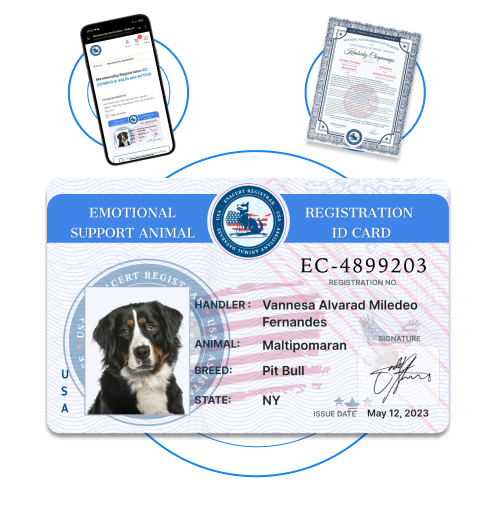
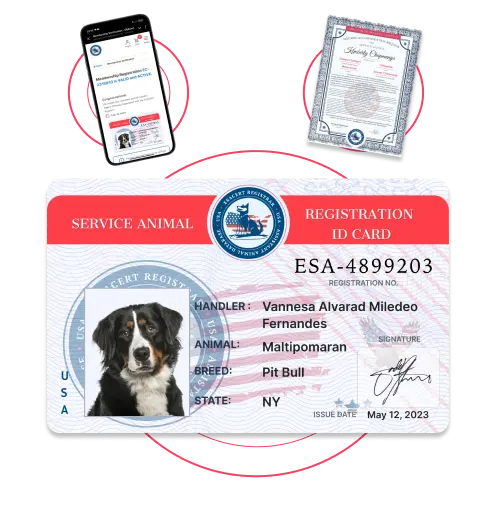
Many handlers find that a clear ID card, certificate, or vest cuts down on awkward questions at a store entrance, an apartment office, or a hotel desk. A service animal registration and ID kit or an emotional support animal registration from ESAcert gives staff something quick to read and keeps your animal’s details in one place.
These tools are a convenience, not a legal requirement. ADA.gov puts it plainly:
“The ADA does not require service animals to wear a vest, ID tag, or specific harness.”
ADA.gov, Frequently Asked Questions about Service Animals and the ADA
A card or vest supports the conversation; the dog’s training, or a licensed professional’s letter for an ESA, is what the law looks at.
Write down the situations where you struggle and whether a dog could perform a repeatable, trainable action that helps. If you can list concrete tasks, research the service dog path.
Talk with your healthcare provider about whether a service dog, psychiatric service dog, or ESA fits your treatment plan.
Before you move or fly, read your landlord’s accommodation process and your airline’s service animal page, and gather the documents each one asks for.
No. ADA.gov states that dogs whose only function is comfort or emotional support do not qualify as service animals. A dog becomes a service animal only when it is individually trained to perform tasks related to a person’s disability.
No. Service dogs may accompany their handlers in places open to the public under the ADA, while ESAs have no ADA public access rights. Some state or local laws allow ESAs in more places, so check the rules where you live.
Ask whether a dog could perform a specific trained action when your symptoms appear, such as responding to the onset of an anxiety attack. If so, a psychiatric service dog may fit. If the help comes from the animal’s presence and companionship, an ESA is the more likely match, and a licensed professional can help you decide.
No federal law requires registration, and ADA.gov says mandatory registration of service animals is not permissible under the ADA. Some owners choose a voluntary registration and ID card for everyday convenience, but it does not create legal rights.
No. Staff may not request documentation, an ID card, or a demonstration. When the dog’s role is not obvious, they may ask only whether the dog is required because of a disability and what task it has been trained to perform.

A valid emotional support animal letter is a short document from a licensed ...
A valid emotional support animal letter is a short document from a licensed health care professional who has evaluated you and believes you have a disability-related need for an emotional support animal. A strong letter is personal to you, written on the provider's letterhead, shows how to verify the license, and connects the animal to how your ...

Yes — the animal itself is still protected. What changed on 22 May 2026 is ...
Yes — the animal itself is still protected. What changed on 22 May 2026 is federal enforcement of pet-fee waivers, and the answer now depends on your state. Updated with the California Civil Rights Department alert of 20 July 2026.

Most people don't realize that California's "no pets" policies cannot be ...
Most people don't realize that California's "no pets" policies cannot be used to deny an emotional support animal. Emotional Support Animal Laws in California give you real, enforceable rights. If your landlord is refusing your ESA based on a no-pet clause, they may be violating both federal and state law. This guide breaks down what those ...


Yes, Virginia protects emotional support animals in housing. The Virginia ...
Yes, Virginia protects emotional support animals in housing. The Virginia Fair Housing Law defines an "assistance animal" to include an animal that provides emotional support for a person's disability (Va. Code § 36-96.1:1), and a separate section, § 36-96.3:1, sets out how a landlord may verify the request and what the tenant pays. Renting with ...

An emotional support animal in Georgia is protected mainly at home: the ...
An emotional support animal in Georgia is protected mainly at home: the federal Fair Housing Act and the Georgia Fair Housing Law (O.C.G.A. § 8-3-200 and following) let you ask a landlord to set aside a no-pets rule as a reasonable accommodation. Outside housing, an ESA has no public access rights, and since July 1, 2026 Georgia law spells that ...

Are you a renter in North Carolina who needs an animal to help with ...
Are you a renter in North Carolina who needs an animal to help with depression or anxiety but fears pet rules or fees? Emotional Support Animal Laws Nc protect tenants under the Fair Housing Act, stop most pet fees, and ban breed and weight limits; Disability Rights North Carolina can help renters. This post will explain housing rights, how ...

If you have an emotional support animal in Texas, your main legal ...
If you have an emotional support animal in Texas, your main legal protection is in housing: the federal Fair Housing Act and the Texas Fair Housing Act (Texas Property Code chapter 301) both require landlords to consider a reasonable accommodation request for an animal you need because of a disability. Texas public-access law, Human Resources Code ...

If your landlord is pushing back on your emotional support animal, the law ...
If your landlord is pushing back on your emotional support animal, the law is on your side in Colorado. The Fair Housing Act gives tenants strong housing protections for ESAs, but these rights have real limits that many people don't discover until they need them most. Most guides stick to the basics. What they often miss are the places where ESA ...
Price:
Your current registration:
After change, your registration will be:
Your current registration:
will be replaced with:
You have entered the maximum number of characters
You have entered the maximum number of characters
You have entered the maximum number of characters
You have entered the maximum number of characters
You have entered the maximum number of characters
EC-0000001
Nov 7, 2026
-
-
-
-
-
-
You have entered the maximum number of characters
You have entered the maximum number of characters
You have entered the maximum number of characters
You have entered the maximum number of characters
You have entered the maximum number of characters
You have entered the maximum number of characters
You have entered the maximum number of characters
Enter at least 3 characters to search. You have entered: