(3)
Spend more to get free priority shipping
Great. You will get complimentary priority shipping for free.
Previous registration has been removed from the cart as only one animal registration is allowed at a one time.

Spend more to get free priority shipping
Great. You will get complimentary priority shipping for free.
Previous registration has been removed from the cart as only one animal registration is allowed at a one time.
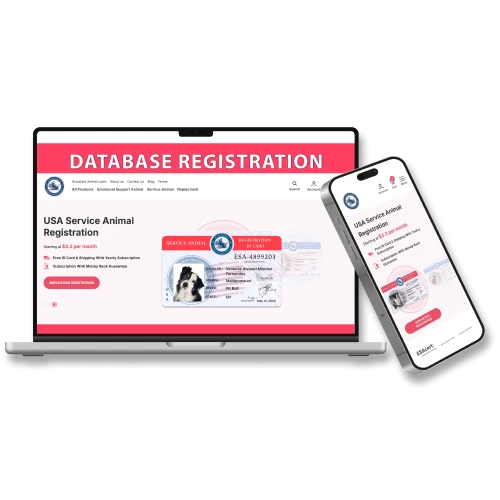
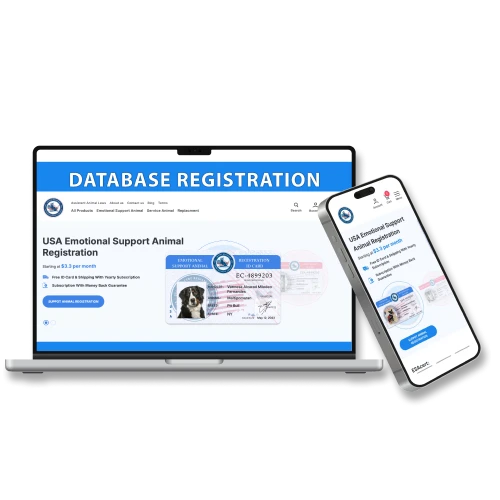
Please note that there is no unified Assistant Animal database registration in the USA.
You cannot verify information from other registrars on the esa-cert.com website

A valid emotional support animal letter is a short document from a licensed health care professional who has evaluated you and believes you have a disability-related need for an emotional support animal. A strong letter is personal to you, written on the provider's letterhead, shows how to verify the license, and connects the animal to how your ...

A valid emotional support animal letter is a short document from a licensed health care professional who has evaluated you and believes you have a disability-related need for an emotional support animal. A strong letter is personal to you, written on the provider’s letterhead, shows how to verify the license, and connects the animal to how your condition affects daily life.
Its main job is housing. Under the federal Fair Housing Act, the letter supports your request for a reasonable accommodation, such as keeping an animal in a building with a no-pet rule. It does not give your animal access to stores or restaurants, and airlines no longer have to accept it for cabin travel.
Below you will find an illustrative sample, a part-by-part breakdown, a comparison table, the red flags worth watching for, and what California adds on top of federal law.
The example below shows how a housing ESA letter is commonly laid out. Bracketed placeholders mark what a real provider fills in from their own records and evaluation.
Illustrative example only, not a form to copy or sign.
[Provider Name, Credentials]
[Practice Name]
[Business Address, City, State, ZIP]
[Phone Number] | [Email Address]
[Date of Letter]
To Whom It May Concern:
I am a [license type] licensed in [State or jurisdiction], license number [number], effective [license effective date]. [Client’s Full Name] has been under my care since [date].
Based on my clinical evaluation, [Client’s Full Name] has a disability within the meaning of the Fair Housing Act. To protect my client’s privacy, this letter does not state a diagnosis.
I have recommended that [Client’s Full Name] keep [type of animal, for example “a dog”] as an emotional support animal. The animal helps reduce the effects of the disability, such as [brief, general description of functional effects, for example difficulty sleeping or difficulty managing daily routines].
I respectfully support [Client’s Full Name]’s request for a reasonable accommodation to live with this animal in [his/her/their] home, including housing with a no-pet policy.
You may contact my office to confirm that I wrote this letter.
Sincerely,
[Signature]
[Provider Typed Name], [Credentials]
[License Type], [State], License #[Number]
Educational illustration only. A real ESA letter must be written and signed by a licensed provider who has personally evaluated you.
Each part of a well-written ESA letter answers a question your housing provider is likely to have: who wrote it, whether that person is licensed, and how the animal relates to your disability. Federal law does not prescribe a fixed template, so treat the list below as practical guidance rather than a legal checklist.
That point matters in 2026. Much of the “what an ESA letter must contain” advice online was built on HUD’s assistance animal notice FHEO-2020-01. HUD has withdrawn that notice and its 2013 predecessor, and the Federal Register says plainly:
“All these guidance documents have been removed from the HUD.gov website and should not be relied upon by internal or external parties.”
The underlying law has not changed. The Fair Housing Act and HUD’s regulation at 24 CFR 100.204 still make it unlawful to refuse reasonable accommodations that may be necessary for a person with a disability to use and enjoy a home. For more on what shifted, see the ESAcert overview of 2026 HUD and housing rules.
One page is plenty. Plain, calm language reads as more credible than dramatic claims about the animal.
Some landlords and websites ask for more than a housing request requires. Leaving extra details out protects your privacy without weakening the letter.
An ESA letter is a housing document. Outside housing, it carries little weight under federal law.
Housing. The letter supports a reasonable accommodation request under the Fair Housing Act. Whether a landlord may charge pet rent, fees or deposits for an emotional support animal depends on federal case law and state law, so ask rather than assume. Enforcement also shifted in 2026: a May 22, 2026 FHEO memo says HUD will recommend charges only in cases involving animals trained to provide disability-related assistance. Tenants can still bring private fair housing claims, and some states, including California, protect emotional support animals under their own laws.
Public places. The ADA covers service animals only. ADA.gov states it directly:
“Dogs whose sole function is to provide comfort or emotional support do not qualify as service animals under the ADA.”
Air travel. Under the Department of Transportation’s rule in 14 CFR Part 382, effective January 11, 2021, airlines may treat emotional support animals as pets. The DOT’s consumer page puts it this way:
“Animal species other than dogs, emotional support animals, comfort animals, companionship animals, and service animals in training are not service animals.”
Travelers with a task-trained service dog may be asked for the DOT service animal forms, which can be required up to 48 hours before departure for flights booked earlier. Check your airline’s own service animal page before flying.
| Housing (FHA) | Air travel (DOT) | Public places (ADA) | |
|---|---|---|---|
| Does an ESA letter help? | Yes, it supports an accommodation request | No, airlines may treat ESAs as pets | No, ESAs have no ADA access rights |
| Training required? | No | Yes, for service dogs | Yes, for service animals |
| Main rule | 42 U.S.C. 3604(f)(3)(B), 24 CFR 100.204 | 14 CFR Part 382 | 28 CFR 35.104, 36.104 |
| Fees | Depends on case law and state law | Airline pet policy applies to ESAs | Not applicable to ESAs |
A licensed health care professional who has evaluated you can write an ESA letter. That often means a psychologist, psychiatrist, licensed clinical social worker, licensed professional counselor, marriage and family therapist, nurse practitioner or physician, acting within the scope of their license. Licensing is regulated state by state, so the provider generally needs a license that allows them to practice where you receive care; confirm this with your provider if you see someone in another state.
California has the most detailed rule. Health and Safety Code section 122318 applies to documentation for an emotional support dog. It requires the practitioner to hold a valid, active license, include the license’s effective date, number, jurisdiction and type, be licensed in the jurisdiction where the documentation is provided, complete a clinical evaluation, and give the client a notice about penalties for falsely claiming a service dog. It also sets a minimum relationship period:
“establishes a client-provider relationship with the individual for at least 30 days prior to providing the documentation”
The statute waives the 30-day period for people verified as homeless, and a practitioner who violates the section may be disciplined by their licensing board. If you live elsewhere, check your own state’s statutes or licensing board rather than assuming California’s rules apply.
For help finding the right person, start with your current therapist or doctor. ESAcert’s guides explain how to ask your doctor for an ESA letter and how to find licensed mental health professionals for ESA letters. If your provider declines, read what to do when a therapist won’t write an ESA letter.
The biggest warning sign is a letter issued without a real evaluation. Landlords can and do question documents that look mass-produced.
If you already bought a questionable letter, a local licensed clinician can review your situation and decide whether a new letter is appropriate after a proper evaluation.
Submit your letter in writing as part of a reasonable accommodation request, and keep copies of everything. A simple order works well:
Responses vary. Some landlords approve quickly, others ask for clarification. Stay focused on the request itself rather than debating your diagnosis.
ESAcert does not write ESA letters, but it offers optional tools that can make the paperwork tidier. The housing request kit gives you structured forms to send alongside your provider’s letter, and an emotional support animal ID card is something simple to show building staff. Both are voluntary conveniences: they do not replace the letter or create legal rights on their own.
No federal law sets an expiration date for an ESA letter. Landlords reviewing a new request may still want information that reflects your current situation, so many tenants ask their provider for an updated letter before a new lease or a move.
No, a housing request does not need your diagnosis or a DSM code. A statement that you have a disability and a disability-related need for the animal is usually enough, and leaving the diagnosis out protects your privacy.
It depends on licensing rules. Providers generally need a license that allows them to practice where you receive care, and California’s statute requires licensure in the jurisdiction where the documentation is provided. Ask your provider to confirm before you rely on the letter.
A landlord may try to confirm that the provider is real and wrote the letter. Without your written permission, providers generally limit what they share about your care, so talk with your provider in advance about how they handle verification calls.
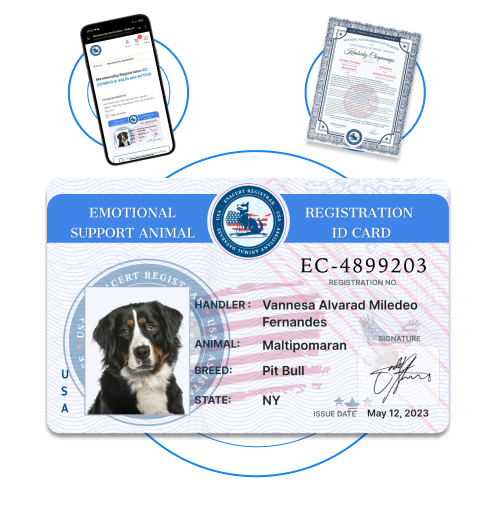
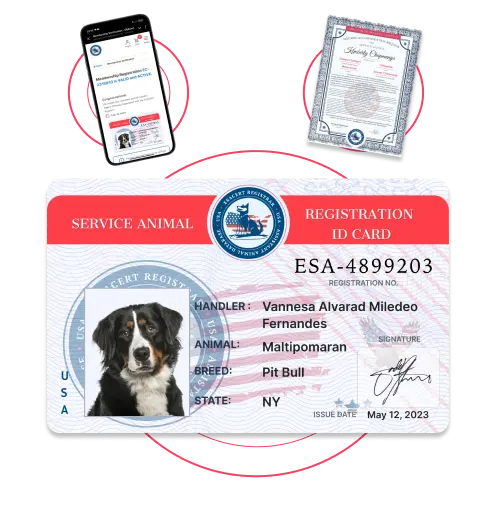
No, registration and ID cards are optional and grant no legal rights; the provider’s letter is what supports a housing request. Some tenants still carry an ID card simply because it is a quick way to show staff that the animal is part of an accommodation request.

A service dog is individually trained to perform specific tasks for a ...
A service dog is individually trained to perform specific tasks for a person with a disability and can go with its handler into most places open to the public. An emotional support animal (ESA) helps through its presence, is not task-trained, and has no ADA right to enter stores, restaurants, or hotels. A therapy dog visits hospitals, schools, and ...

Yes — the animal itself is still protected. What changed on 22 May 2026 is ...
Yes — the animal itself is still protected. What changed on 22 May 2026 is federal enforcement of pet-fee waivers, and the answer now depends on your state. Updated with the California Civil Rights Department alert of 20 July 2026.

Most people don't realize that California's "no pets" policies cannot be ...
Most people don't realize that California's "no pets" policies cannot be used to deny an emotional support animal. Emotional Support Animal Laws in California give you real, enforceable rights. If your landlord is refusing your ESA based on a no-pet clause, they may be violating both federal and state law. This guide breaks down what those ...


Yes, Virginia protects emotional support animals in housing. The Virginia ...
Yes, Virginia protects emotional support animals in housing. The Virginia Fair Housing Law defines an "assistance animal" to include an animal that provides emotional support for a person's disability (Va. Code § 36-96.1:1), and a separate section, § 36-96.3:1, sets out how a landlord may verify the request and what the tenant pays. Renting with ...

An emotional support animal in Georgia is protected mainly at home: the ...
An emotional support animal in Georgia is protected mainly at home: the federal Fair Housing Act and the Georgia Fair Housing Law (O.C.G.A. § 8-3-200 and following) let you ask a landlord to set aside a no-pets rule as a reasonable accommodation. Outside housing, an ESA has no public access rights, and since July 1, 2026 Georgia law spells that ...

Are you a renter in North Carolina who needs an animal to help with ...
Are you a renter in North Carolina who needs an animal to help with depression or anxiety but fears pet rules or fees? Emotional Support Animal Laws Nc protect tenants under the Fair Housing Act, stop most pet fees, and ban breed and weight limits; Disability Rights North Carolina can help renters. This post will explain housing rights, how ...

If you have an emotional support animal in Texas, your main legal ...
If you have an emotional support animal in Texas, your main legal protection is in housing: the federal Fair Housing Act and the Texas Fair Housing Act (Texas Property Code chapter 301) both require landlords to consider a reasonable accommodation request for an animal you need because of a disability. Texas public-access law, Human Resources Code ...

If your landlord is pushing back on your emotional support animal, the law ...
If your landlord is pushing back on your emotional support animal, the law is on your side in Colorado. The Fair Housing Act gives tenants strong housing protections for ESAs, but these rights have real limits that many people don't discover until they need them most. Most guides stick to the basics. What they often miss are the places where ESA ...
Price:
Your current registration:
After change, your registration will be:
Your current registration:
will be replaced with:
You have entered the maximum number of characters
You have entered the maximum number of characters
You have entered the maximum number of characters
You have entered the maximum number of characters
You have entered the maximum number of characters
EC-0000001
Nov 7, 2026
-
-
-
-
-
-
You have entered the maximum number of characters
You have entered the maximum number of characters
You have entered the maximum number of characters
You have entered the maximum number of characters
You have entered the maximum number of characters
You have entered the maximum number of characters
You have entered the maximum number of characters
Enter at least 3 characters to search. You have entered: