(3)
Spend more to get free priority shipping
Great. You will get complimentary priority shipping for free.
Previous registration has been removed from the cart as only one animal registration is allowed at a one time.

Spend more to get free priority shipping
Great. You will get complimentary priority shipping for free.
Previous registration has been removed from the cart as only one animal registration is allowed at a one time.
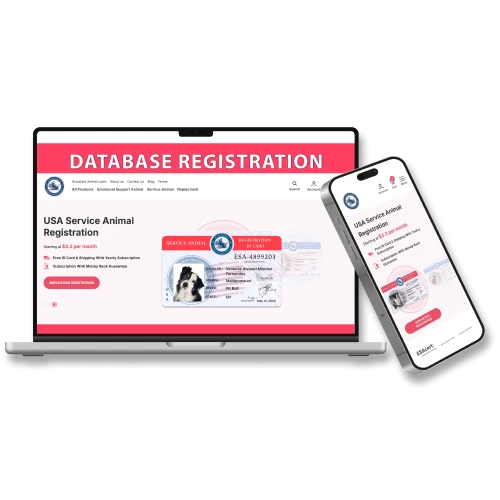
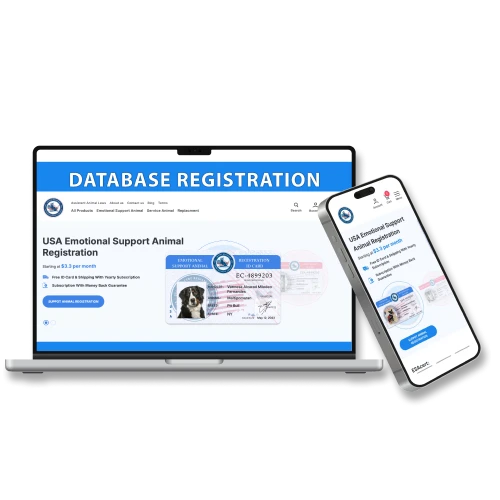
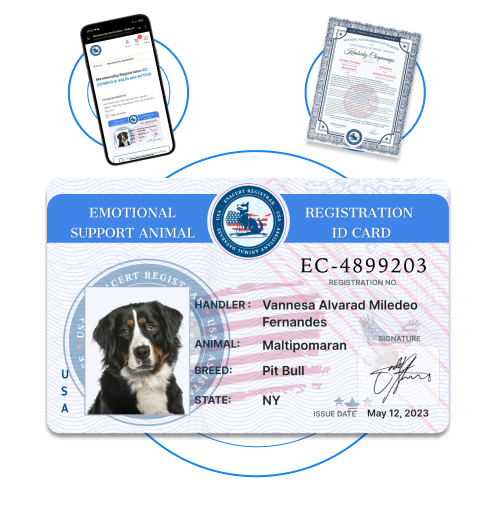
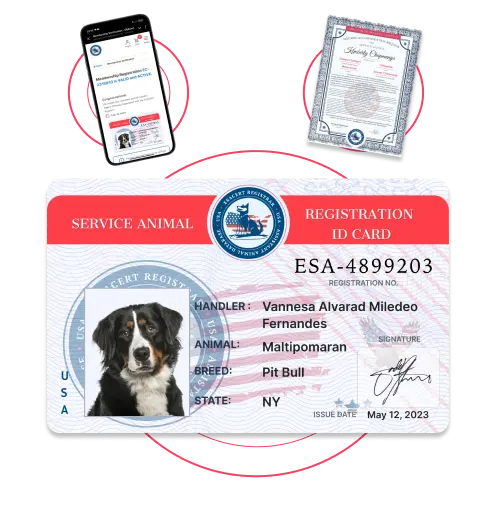
Please note that there is no unified Assistant Animal database registration in the USA.
You cannot verify information from other registrars on the esa-cert.com website

Flying with a service animal requires submitting airline-specific forms confirming the dog’s training, behavior, and health. Preparing documentation early and using clear identification helps ensure a smooth, compliant travel experience.


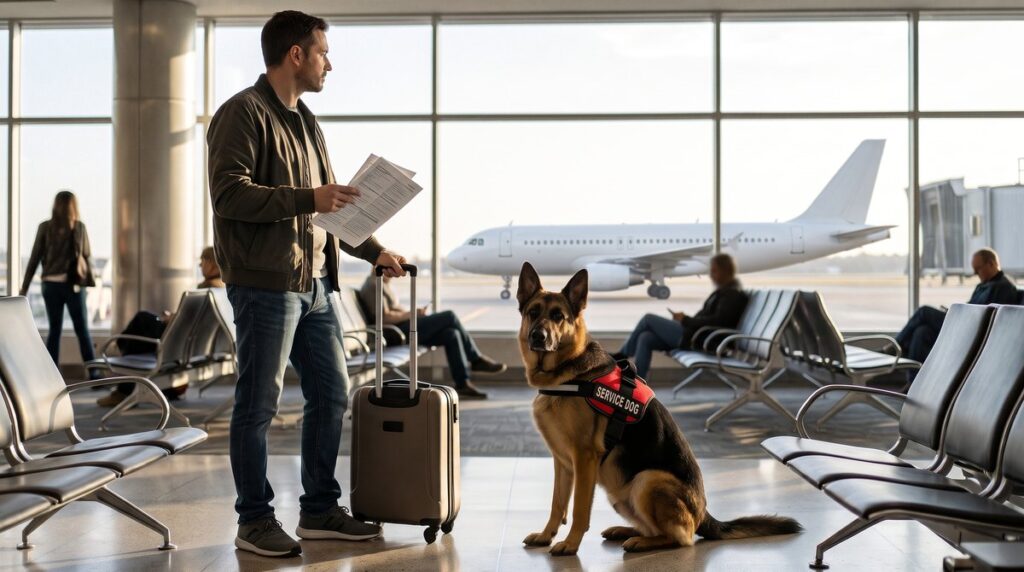
Service dogs on flights travel in the cabin with their handler at no charge, as long as the dog is individually trained to do work or perform tasks for a person with a disability and behaves well in public. US airlines may ask you to complete the US DOT Service Animal Air Transportation Form and, if you booked more than 48 hours before departure, to send it up to 48 hours ahead.
The rules come from the Air Carrier Access Act regulations in 14 CFR Part 382, which the Department of Transportation rewrote in a final rule effective January 11, 2021. Below you will find what the federal rules say, how Delta, American, Southwest and United handle the DOT form, and what to do at the airport, on board, abroad and if something goes wrong.
Key takeaways
On US flights, a service animal is a trained dog, and airlines must let it travel with you in the cabin. The definition sits in 14 CFR 382.3, and the service animal rules themselves are in Subpart E, sections 382.72 through 382.80.
The Department of Transportation (DOT) defines a service animal by what the dog is trained to do, not by any registration or paperwork. Here is the definition word for word:
Service animal means a dog, regardless of breed or type, that is individually trained to do work or perform tasks for the benefit of a qualified individual with a disability, including a physical, sensory, psychiatric, intellectual, or other mental disability. Animal species other than dogs, emotional support animals, comfort animals, companionship animals, and service animals in training are not service animals for the purposes of this part.
Source: eCFR, 14 CFR 382.3.
A psychiatric service dog qualifies when it performs trained tasks, for example interrupting a panic attack. If you are unsure which category your dog falls into, our guide to psychiatric service dogs explains the line between a task and comfort. Airlines also may not refuse a dog because of its breed or type, or because its presence may offend or annoy crew or other passengers (14 CFR 382.72).
Emotional support animals lost their service animal status in the cabin when the 2021 rule took effect. The DOT summarized the change in the Federal Register:
It allows airlines to recognize emotional support animals as pets, rather than service animals, and permits airlines to limit the number of service animals that one passenger can bring onboard an aircraft to two service animals.
Source: Federal Register, Traveling by Air With Service Animals, final rule of December 10, 2020.
Delta, American, Southwest and United all now fly ESAs under their pet policies, which usually means a carrier under the seat and a pet fee. The differences between a service dog and an emotional support animal matter far more in the air than they used to, and our page on ESA travel and airline regulations covers the pet side in more detail.
An airline is not required to accept more than two service animals for a single passenger with a disability (14 CFR 382.74). Each dog needs its own DOT form, and both have to fit on your lap or in your foot space.
Service dogs in training are not service animals under Part 382, so airlines may treat them as pets. American, Southwest and United say so on their service animal pages, and Delta’s FAQ notes that a dog in training may travel with a professional trainer on its way to its new owner, under Delta’s rules. Plan a training flight around the airline’s pet policy, and see our service dog training resources for getting a dog ready for public spaces first.
The DOT form is the only document an airline may require for a service dog, and the 48-hour deadline is a ceiling, not a rule every airline uses. Federal rules allow two forms:
Airlines may not ask for anything beyond these forms, such as a doctor’s letter, ID card or certificate, except to meet animal-entry rules of a federal agency, a US territory or a foreign country (382.75(c)). The forms are free. Airlines that require them must post them on their websites in an accessible format, keep copies at every airport they serve, and mail them to you on request.
The advance deadline depends on when you booked. Here is the rule in the regulation’s own words:
If a passenger’s reservation was made more than 48 hours in advance of the first originally scheduled departure time on the passenger’s itinerary, you may require that passenger provide up to 48 hours advance notice by submitting the form identified in paragraph (a) of this section.
Source: eCFR, 14 CFR 382.75(g)(1).
Filling the form in by hand works fine. If you would rather have a clean, complete copy ready to sign, the ESAcert Service Dog DOT Form kit prepares it from your details as a PDF or printed copy. You still sign every attestation yourself, and every statement must be true. Handlers who also want a voluntary ID card and travel gear in one order can look at the Service Dog Airlines Bundle. Neither product is required by any airline or by law, and neither grants legal rights; the free DOT form is what airlines actually ask for.
Each airline sets its own process inside the federal limits, so the same form can be due online two days ahead on one carrier and at the gate on another. The table below shows what each airline publishes on its own service animal page, as of our last review.
| Airline | Where to submit the DOT form | How far ahead | Our detailed guide |
|---|---|---|---|
| Delta Air Lines | “Submit Completed Forms” button on Delta’s service animal page (accessibility service request, “Trained Service Animal” box in Step 4). Printed copies can also be brought to the airport if you need help. | At least 48 hours before departure. Relief form for flights of 8 hours or more. | Delta service animal policy |
| American Airlines | Electronically to American’s Special Assistance Desk, or present the completed form at the airport on travel day (arrive early). Approval brings a SVAN ID for future trips with the same dog. | Recommended at least 48 hours before the flight. Relief form if a flight is over 8 hours. | American Airlines service animal policy |
| Southwest Airlines | In person, printed or digital, to a Customer Service Agent at the ticket counter or departure gate. You can note the dog on your reservation online. | On the day of travel. No advance deadline published. | Southwest service animal policy |
| United Airlines | Domestic: choose the service dog option when booking, then complete the form in Trip Details (or save it in your MileagePlus profile). International, Hawaii and Guam: call United’s accessibility desk at 1-800-228-2744 first. | No deadline stated on United’s page; complete it right after booking. Relief form for flights of 8 hours or more. | United Airlines service dog policy |
Airline policies change, so confirm on your carrier’s service animal page before every trip. On a codeshare or partner flight, check the operating airline’s rules too, since it may collect the forms itself.
Preparation starts at booking: pick a seat with room for the dog, complete the forms after you buy the ticket, and make sure your dog can handle a crowded terminal. Most problems at the gate come from missing forms, a dog that does not fit, or behavior, not from the law.
Tell the airline about your service dog when you book or soon after, and send the DOT form the way your airline asks. Even when no deadline applies, early notice lets the airline plan seating and spares you a scramble at the counter. Avoid exit rows: all four airlines in the table bar service animals from them.
Your dog may ride on your lap or in your foot space, as long as that is consistent with safety rules and the dog does not encroach into another passenger’s space (14 CFR 382.77(a)). For a large dog, the airline must first offer you another seat in the same class of service where the dog fits, if one is available. It does not have to give you a free extra seat or move other passengers, though some airlines let you buy a seat for the floor space.
If no option works on your scheduled flight, the airline must offer to carry the dog in the cargo hold free of charge or to put you on a later flight with space (382.77(c)). Neither is ideal, so measure your dog lying down against the foot space of the aircraft you booked.
TSA screens you and your service dog together and will not separate you. You can walk through the metal detector with the dog or lead it through separately on a leash. If the detector alarms, both of you get additional screening, which for the dog may include a visual inspection or pat-down to make sure it is not carrying prohibited items.
The officer will ask for your help before touching the dog or its gear. Collars, harnesses, leashes, vests and backpacks are screened, but items you need to control the dog or that show it is working do not have to come off. If you leave the checkpoint to take the dog to a relief area, you will need to be screened again.
On board, your dog stays on your lap or at your feet, under your control, for the whole flight. Behavior is what airline staff watch most closely, and it is the most common lawful reason to refuse a dog.
Your service dog will usually lie in the space in front of your seat. A small dog may sit on your lap if that can be done safely. The dog may not block the aisle or an emergency exit, and an airline is not required to upgrade you to another class to make room. If you need a specific seat, such as a bulkhead, ask when you book.
Use the airport’s service animal relief area right before boarding; airline or airport staff can tell you where the nearest one is. On a segment of 8 hours or more, the airline may ask for the relief attestation form, where you confirm the dog will not need to go, or can go without creating a health or sanitation issue. Relieving itself in the cabin or gate area is one of the behaviors that can lead an airline to refuse a dog, so build up your dog’s comfort with long stretches before a long flight.
Staff may ask only two questions: whether the dog is required because of a disability, and what work or task it has been trained to perform. They may not ask about the nature or extent of your disability or ask the dog to demonstrate its task (14 CFR 382.73). They may also observe the dog and look for a harness or vest, and they may require the dog to be harnessed, leashed or otherwise tethered at all times in the airport and on the plane.
Under 382.79, an airline may deny transport when the dog:
The airline must assess the individual dog, not its breed, and must consider steps short of refusal first, for example muzzling a barking dog. If it does refuse, it must give you a written statement of the reason, at the airport or within 10 calendar days. An airline may charge you for damage your dog causes, but only if it charges other passengers for similar damage (382.78).
International trips add a second set of rules on top of the DOT form: the destination country’s animal-entry requirements, and the US rules for coming home. Start early, because some countries require vaccinations, tests or permits weeks or months ahead, and not all countries accept service animals from abroad.
Rules for specific destinations change often, so treat this as a checklist of what to look up, not as a promise that your dog will be admitted.
If an airline mishandles your service dog, ask for its Complaints Resolution Official (CRO) on the spot, then file a written complaint with the airline and, if needed, with the DOT. Acting quickly matters, because the deadlines are short.
Keep your DOT forms, boarding passes, any written refusal and the names of staff you spoke with. Problems at the TSA checkpoint are a security matter: ask for a supervisor or passenger support specialist at the checkpoint, or contact TSA Cares at (855) 787-2227 before you travel.
Airlines may ask only for the US DOT Service Animal Air Transportation Form, plus the Relief Attestation Form for a flight segment of 8 hours or more. They may not demand a doctor’s letter, registration, ID card or certificate, except for government animal-entry rules on international or territorial trips. A voluntary ID card can make questions quicker to answer, but it is not proof under federal rules and grants no legal rights.
Only if your airline asks for it and you booked more than 48 hours before departure. If you booked later, the airline may only ask you to hand the forms in at the gate. Southwest, for example, collects the form at the counter or gate on travel day, while Delta asks for it at least 48 hours ahead.
Airlines watch behavior closely. A dog that runs loose, barks or growls repeatedly, bites, jumps on people or relieves itself in the cabin or gate area can be refused, even if it performs a task for you. The airline must judge the individual dog rather than its breed, consider fixes short of refusal, and explain any refusal in writing.
Yes. TSA screens you and your service dog together and will not separate you, and you can walk through the metal detector with the dog or lead it through on a leash. If the detector alarms, the dog may get a visual inspection or pat-down, and the officer will ask for your help before touching it.
Usually not. Since 2021, federal rules let airlines treat emotional support animals as pets, and Delta, American, Southwest and United all do. An ESA can still travel with you under the airline’s pet policy, typically in a carrier with a pet fee.
Ask for the airline’s Complaints Resolution Official right away and request the written statement of the reason for the refusal, which the airline must provide. You can then file a complaint with the airline and with the DOT, within 6 months of the incident. For the ADA rules that apply outside the airport, see our guide to service dog requirements under the ADA.

A psychiatric service dog (PSD) is a dog individually trained to perform ...
A psychiatric service dog (PSD) is a dog individually trained to perform specific tasks for a person with a mental health disability such as PTSD, panic disorder, major depression or bipolar disorder. Because it is task-trained, a PSD is a service animal under the Americans with Disabilities Act (ADA) and can go with its handler into stores, ...
Delta accepts fully trained service dogs in the cabin at no charge, while ...
Delta accepts fully trained service dogs in the cabin at no charge, while emotional support animals travel only under Delta's pet rules. To fly with a service dog, you complete the U.S. DOT Service Animal Air Transportation Form and send it to Delta with a service request, ideally at least 48 hours before departure.

A valid emotional support animal letter is a short document from a licensed ...
A valid emotional support animal letter is a short document from a licensed health care professional who has evaluated you and believes you have a disability-related need for an emotional support animal. A strong letter is personal to you, written on the provider's letterhead, shows how to verify the license, and connects the animal to how your ...
A service dog is individually trained to perform specific tasks for a ...
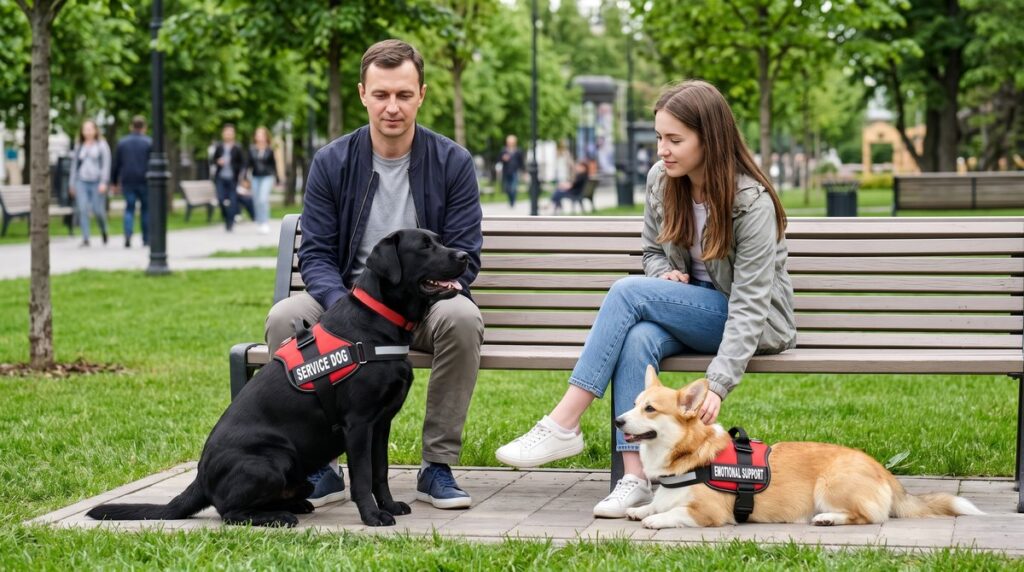
A service dog is individually trained to perform specific tasks for a person with a disability and can go with its handler into most places open to the public. An emotional support animal (ESA) helps through its presence, is not task-trained, and has no ADA right to enter stores, restaurants, or hotels. A therapy dog visits hospitals, schools, and ...

Yes — the animal itself is still protected. What changed on 22 May 2026 is ...
Yes — the animal itself is still protected. What changed on 22 May 2026 is federal enforcement of pet-fee waivers, and the answer now depends on your state. Updated with the California Civil Rights Department alert of 20 July 2026.

Most people don't realize that California's "no pets" policies cannot be ...
Most people don't realize that California's "no pets" policies cannot be used to deny an emotional support animal. Emotional Support Animal Laws in California give you real, enforceable rights. If your landlord is refusing your ESA based on a no-pet clause, they may be violating both federal and state law. This guide breaks down what those ...

Yes, Virginia protects emotional support animals in housing. The Virginia ...
Yes, Virginia protects emotional support animals in housing. The Virginia Fair Housing Law defines an "assistance animal" to include an animal that provides emotional support for a person's disability (Va. Code § 36-96.1:1), and a separate section, § 36-96.3:1, sets out how a landlord may verify the request and what the tenant pays. Renting with ...

An emotional support animal in Georgia is protected mainly at home: the ...
An emotional support animal in Georgia is protected mainly at home: the federal Fair Housing Act and the Georgia Fair Housing Law (O.C.G.A. § 8-3-200 and following) let you ask a landlord to set aside a no-pets rule as a reasonable accommodation. Outside housing, an ESA has no public access rights, and since July 1, 2026 Georgia law spells that ...
Price:
Your current registration:
After change, your registration will be:
Your current registration:
will be replaced with:
You have entered the maximum number of characters
You have entered the maximum number of characters
You have entered the maximum number of characters
You have entered the maximum number of characters
You have entered the maximum number of characters
EC-0000001
Nov 17, 2026
-
-
-
-
-
-
You have entered the maximum number of characters
You have entered the maximum number of characters
You have entered the maximum number of characters
You have entered the maximum number of characters
You have entered the maximum number of characters
You have entered the maximum number of characters
You have entered the maximum number of characters
Enter at least 3 characters to search. You have entered: